Solana HFT market structure in 2026
Solana’s DeFi landscape has shifted from experimental liquidity pools to a high-throughput trading venue capable of supporting institutional-grade high-frequency strategies. The network’s architecture now handles transaction finality in sub-second intervals, creating a microstructure where latency arbitrage and market-making remain viable, though increasingly competitive. This viability hinges on recent protocol upgrades that have stabilized block production and reduced the variance in transaction confirmation times.
For quant traders, the critical infrastructure layer is no longer just about speed, but about reliability and data accessibility. The transition to newer RPC providers and dedicated validator nodes has mitigated the "failed transaction" rates that plagued earlier iterations of Solana DeFi. This stability allows HFT algorithms to execute complex, multi-leg trades without the risk of partial fills or unexpected reverts due to network congestion. The market depth in major pairs like SOL/USDC is now sufficient to absorb larger order sizes without significant slippage, a prerequisite for scalable HFT operations.
The profitability of aggressive HFT strategies—those that take liquidity rather than provide it—remains robust, particularly in the short-to-medium time horizons of seconds to minutes. These strategies extract value from less efficient market participants and broader market movements. However, the barrier to entry has risen; success now depends less on raw speed alone and more on sophisticated data feeds and low-latency execution paths. The current environment rewards those who can process on-chain data and react to price changes faster than the average market participant.
Latency infrastructure and node setup
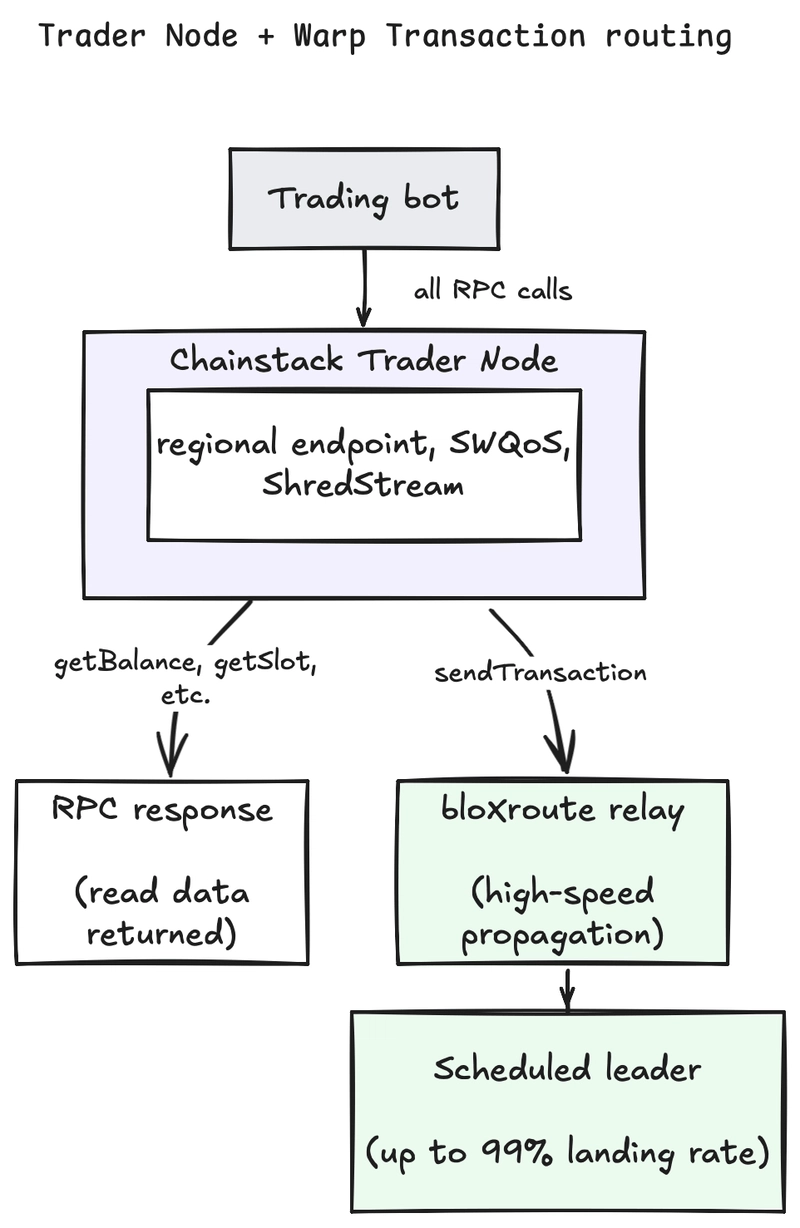
In Solana HFT, latency is measured in microseconds, not milliseconds. Sub-50ms execution is the new baseline for alpha, and the gap between a profitable bot and a failing one often comes down to where your node sits relative to the validator network. General-purpose cloud instances are insufficient for serious trading; you need a dedicated infrastructure stack designed to minimize every hop.
Colocation and Network Topology
Proximity to the validator is the single most significant factor in reducing round-trip time. Deploying your infrastructure in the same data center as the primary validator nodes—typically in major hubs like Tokyo, New York, or Amsterdam—can shave tens of milliseconds off your execution time. This isn't just about physical distance; it's about avoiding the public internet's unpredictable routing and congestion.
If colocation isn't feasible, consider dedicated high-bandwidth connections with low-latency routing to the validator's region. The goal is to create a direct, private path between your trading engine and the consensus layer, bypassing the noise of the broader internet.
RPC Node Configuration
Standard public RPC endpoints are too slow and unreliable for HFT. You need a dedicated, high-performance RPC node that is tuned for speed and consistency. This involves:
- Dedicated Hardware: Use NVMe SSDs and high-core-count CPUs to handle the high transaction throughput without bottlenecks.
- Optimized Networking: Enable TCP_NODELAY and disable Nagle's algorithm to ensure packets are sent immediately.
- Local State Access: Keep the node's state local to avoid network latency when querying account data or transaction history.
The choice of RPC provider matters, but so does your internal configuration. A poorly tuned node on a fast connection will still lag behind a well-optimized one on a slightly slower link. Focus on reducing CPU context switches and memory allocation overhead in your trading software.
Execution Engine Optimization
Your trading engine must be written in a low-latency language like Rust or C++. Python is generally too slow for the core execution loop, though it can be used for high-level strategy logic. The critical path—receiving updates, making decisions, and broadcasting transactions—must be streamlined to avoid any unnecessary delays.
Use asynchronous I/O and non-blocking data structures to handle the high volume of incoming updates. Pre-allocate memory for transactions and reuse objects where possible to reduce garbage collection pauses. Every microsecond counts, so profile your code rigorously to identify and eliminate bottlenecks.
TechnicalChart symbol="BINANCE:SOLUSDT" chartStyle="candle" interval="1H" indicators="["volume"]" />
Top Solana DEXs for HFT execution
High-frequency trading on Solana relies on minimizing slippage and latency. The choice of decentralized exchange (DEX) dictates your execution quality, especially during periods of high volatility. While Solana’s base layer offers sub-second finality, the routing logic and liquidity pools of individual protocols determine actual fill rates.
The market is dominated by a few key players, each optimized for different trading styles. JitoSwap and Raydium offer deep liquidity for major pairs, while Meteora provides dynamic fee structures for concentrated liquidity strategies. For pure speed, Jito’s integration with the block builder ecosystem allows HFT bots to front-run or sandwich transactions more effectively than on standard pools.
Execution Comparison
The table below compares the primary Solana DEXs based on metrics relevant to algorithmic trading: average slippage for standard swaps, fee structures, and available depth for large orders.
| DEX | Avg Slippage (10k USD) | Fee Structure | Liquidity Depth |
|---|---|---|---|
| JitoSwap | < 0.1% | 0.25% + Priority | High |
| Raydium | 0.1% - 0.5% | 0.25% | High |
| Meteora | < 0.05% (DLMM) | Variable (0.01%-1%) | Medium-High |
| Orca | 0.05% - 0.3% | 0.1% - 0.3% | Medium |
Latency and Infrastructure
For HFT, the DEX is only as good as your connection to it. JitoSwap’s MEV-protected bundles allow you to submit transactions with explicit priority fees, ensuring inclusion even during network congestion. Raydium’s integration with Serum’s order book (now migrating to new structures) offers a hybrid model where limit orders coexist with AMM pools, providing additional liquidity layers.
Meteora’s DLMM (Discrete Liquidity Market Maker) model allows for capital efficiency that mimics centralized exchange limit books, reducing slippage for large orders. However, it requires more complex position management. Orca’s Whirlpools offer similar concentrated liquidity but with a more user-friendly interface, making it a viable secondary option for bots that prioritize ease of integration over maximum edge.
Hardware and Tools
To execute these strategies, you need reliable infrastructure. Below are recommended tools for monitoring and trading on Solana DEXs.
![[Brass Edition] Safe Seed Crypto Metal Wallet Stamp Plate - 12-25 Words Recovery Passphrase Cold Storage Bitcoin Ethereum BNB Cardano Solana ERC20 BIP39 Hardware Wallet Cryptocurrency](https://m.media-amazon.com/images/I/51kerXHU8-L._AC_UY654_QL65_.jpg)
As an Amazon Associate, we may earn from qualifying purchases.
Essential Tools and Bot Development
Automating a trading strategy on Solana requires a specialized software stack. You cannot rely on standard retail interfaces for high-frequency operations. Your infrastructure needs to prioritize low-latency execution, robust error handling, and direct access to the mempool.
The Core Infrastructure Stack
At the foundation, you need a high-performance RPC node. Public endpoints are insufficient for HFT because of rate limits and network congestion. Most serious traders run dedicated validators or subscribe to premium RPC providers like Helius or Triton to ensure consistent block subscription and transaction inclusion.
Your bot’s execution layer must interact directly with the Solana blockchain’s transaction model. This involves constructing transactions that bundle multiple instructions, such as token swaps and stake activations, into a single atomic unit. Using libraries like @solana/web3.js or Rust-based SDKs allows you to optimize transaction size and compute unit consumption.
MEV Protection and Order Routing
Solana’s high throughput attracts sophisticated searchers. Without protection, your large orders are vulnerable to sandwich attacks and front-running. Implementing MEV protection is not optional; it is a cost of doing business.
You can route orders through protected endpoints provided by major RPC services, which hold transactions in a private mempool until they are included in a block. Alternatively, you can integrate with decentralized MEV-protect protocols or use private transaction relays. These tools ensure your trade executes at the intended price without being intercepted by predatory bots.

Monitoring and Analytics
Finally, your bot needs real-time data feeds. Delayed order book data leads to stale quotes and missed opportunities. Subscribe to WebSocket streams from DEX aggregators or liquidity pools to get millisecond-accurate price updates.
For historical analysis and backtesting, use on-chain data platforms like Dune Analytics. These tools allow you to query past transactions to verify your strategy’s performance against actual market conditions. This data-driven approach helps you refine your parameters before deploying capital.
Alpha strategies and risk management
High-frequency trading on Solana relies on two primary alpha engines: arbitrage and market making. Arbitrage exploits price discrepancies between decentralized exchanges (DEXs) like Raydium or Orca and centralized exchanges (CEXs). Because Solana’s block times are measured in milliseconds, these opportunities vanish quickly. Profitability depends on low-latency infrastructure that can detect, calculate, and execute trades before the market corrects. Market making, conversely, involves providing liquidity to capture the bid-ask spread. This strategy requires precise inventory management to avoid adverse selection, where informed traders exploit your quotes against you.
The infrastructure behind these strategies determines success. Traditional Solana transactions often suffer from congestion and unpredictable ordering. Solutions like MagicBlock’s Ephemeral Rollups address this by offering sub-50ms latency, predictable transaction costs, and First-Come-First-Served (FCFS) sequencing. This consistency is critical for HFT bots that must execute within tight time windows. Without such infrastructure, slippage and failed transactions erode margins, turning potential profits into losses.
Risk mitigation is just as important as alpha generation. HFTs operate in a high-stakes environment where a single bug or network spike can wipe out positions. A disciplined approach includes predefined exit triggers, strict position limits, and real-time monitoring of protocol health. For example, if a DEX’s liquidity pool drops below a certain threshold, the bot should immediately halt trading to avoid executing against stale prices. Regular audits of smart contracts and monitoring of on-chain metrics help identify potential vulnerabilities before they impact capital.
-
Set slippage tolerance limits
-
Define gas transaction limits
-
Configure automatic exit triggers
Frequently asked: what to check next
Is high-frequency trading still profitable on Solana?
Yes, but the profit pool has shifted. Recent research indicates that aggressive HFTs—those that take liquidity rather than provide it—continue to generate high Sharpe ratios. These strategies extract value from other market participants, primarily within seconds to minutes of execution. The key is not just speed, but the ability to capture short-term inefficiencies before the market corrects.
What defines a Solana DeFi strategy for HFT?
Unlike passive yield farming, an HFT strategy is a disciplined, structured allocation of assets across risk-tiered protocols. It relies on predefined rebalancing rules, strict position limits, and automated exit triggers. The goal is to manage volatility and protocol risk through precise, algorithmic execution rather than long-term holding.
What infrastructure is required for Solana HFT?
Success depends on low-latency connectivity to the network. This typically involves running validator nodes or using dedicated RPC endpoints to minimize block propagation delays. Traders also leverage on-chain tools like Dune Analytics to monitor HFT activity and identify viable opportunities across different EVM and Solana-based DEXs.
How does Solana HFT differ from traditional DEX HFT?
Solana’s high throughput and low fees allow for a higher volume of micro-transactions compared to Ethereum L1s. This reduces the cost of failed attempts and enables strategies that are economically unviable on slower chains. However, it requires specialized tooling to handle the unique consensus mechanics and transaction ordering of the Solana network.
No comments yet. Be the first to share your thoughts!