Why Solana Fits High-Frequency Trading
High-frequency trading on Solana isn't just about speed; it's about the structural economics of the chain. For an HFT strategy to work, the cost of execution must be negligible compared to the spread you're capturing, and the latency between signal and transaction must be minimal. Solana's architecture delivers both in a way that other L1s struggle to match.
The primary advantage is transaction finality. Solana processes blocks approximately every 400 milliseconds, creating a tight, predictable cadence for order execution. This rapid block time allows algorithms to react to market movements almost instantly, reducing the window for slippage or adverse selection. In contrast, chains with longer block times or variable confirmation delays force traders to either wait longer for safety or accept higher uncertainty.
Equally important is the fee structure. HFT strategies rely on high volume, where even a fraction of a cent in gas can erode profits. Solana's parallel transaction processing (Sealevel) keeps fees consistently low, often fractions of a cent per transaction. This allows for dense packing of trades—such as arbitrage or market-making strategies—without the prohibitive costs that plague congested networks. The combination of sub-second finality and near-zero fees creates the necessary infrastructure for profitable high-frequency activity.
Node architecture for sub-50ms latency
Competitive high-frequency trading on Solana isn’t just about writing efficient code; it’s about shrinking the physical distance between your execution logic and the network. To consistently achieve sub-50ms latency, you need to strip away the virtualization overhead that standard cloud providers introduce. Bare-metal servers are the baseline, but for serious arbitrage or market-making strategies, colocation is often non-negotiable.
Hardware and Network Requirements
The first step is moving your nodes into data centers that house Solana validator clusters. Providers like MagicBlock offer ephemeral rollups and colocation services that place your trading infrastructure in the same physical rack or nearby availability zones as the primary validators. This proximity reduces network hops and minimizes jitter, which is the erratic delay that can ruin a time-sensitive trade.
Beyond location, your hardware must be tuned for high-throughput packet processing. You’ll want dedicated CPU cores pinned to your trading bots to prevent context switching, and network interfaces configured for zero-copy data handling. Standard AWS EC2 instances will introduce enough variance in latency to make you uncompetitive against firms running on optimized bare-metal stacks.
RPC Optimization
Your connection to the blockchain is just as critical as your physical location. Relying on public RPC endpoints is a fast track to missed opportunities. Instead, establish dedicated gRPC or HTTP connections to private RPC providers that offer transaction prioritization and direct validator feeds. These private channels allow you to submit transactions with higher priority fees and receive block updates faster than the general public.
Measuring and Monitoring Latency
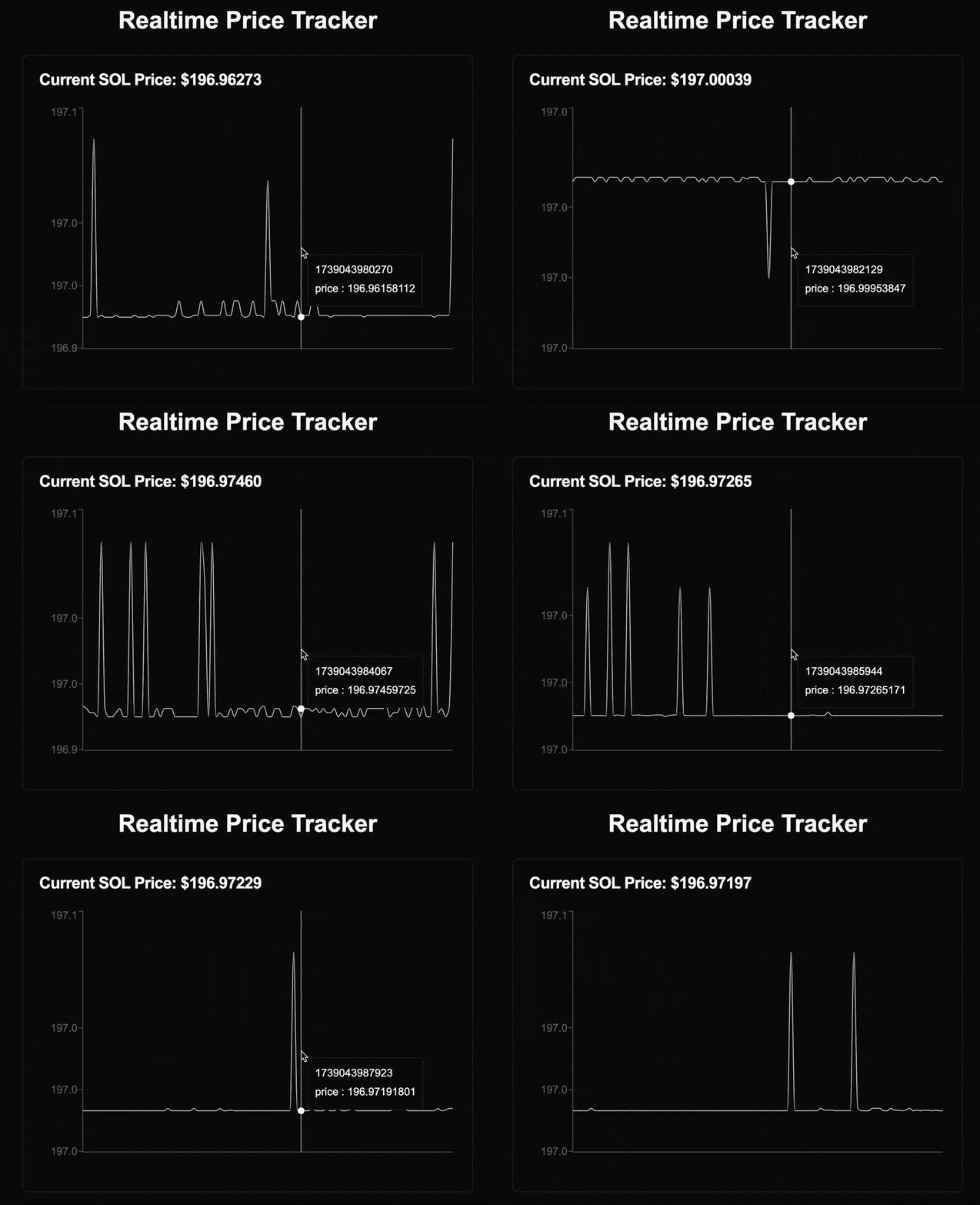
You can’t optimize what you don’t measure. Implement internal latency tracking that logs the time from strategy signal generation to transaction submission, and from submission to confirmation. Tools like solana perf-stats and custom monitoring agents can help you identify bottlenecks in your local network stack or RPC response times. Aim for a p99 latency under 50ms to ensure your strategies remain viable during high-volatility events.
Execution strategies and MEV protection
High-frequency trading on Solana requires more than just fast code; it demands infrastructure that minimizes latency while shielding orders from front-running. Public mempools are transparent, meaning any pending transaction is visible to bots before it lands on-chain. To trade effectively, you must separate your execution logic from the public relay network.
Arbitrage and Market Making Mechanics
Arbitrage relies on capturing price discrepancies between decentralized exchanges (DEXs) and centralized venues (CEXs). On Solana, this involves monitoring order books across Raydium, Orca, and Jupiter, then executing trades in a single atomic transaction to ensure profit. Market making requires placing continuous limit orders to capture the spread. Both strategies demand sub-50ms latency to remain profitable against competing bots.
Mitigating MEV with Private Relays
Maximum Extractable Value (MEV) bots scan the public mempool for profitable trades. If your arbitrage or market-making order is visible, it will likely be front-run, eroding your margin. The solution is using private relays or encrypted mempools. These services submit your transaction directly to validators or through a trusted sequencer, bypassing the public gossip network. This ensures your trade is private until it is confirmed, neutralizing the front-running threat.
Public RPC vs. Private Relay Comparison
Choosing the right execution path is critical. Below is a comparison of standard public RPC execution versus private relay execution, highlighting the trade-offs in latency, visibility, and cost.
| Feature | Public RPC | Private Relay | Ephemeral Rollup |
|---|---|---|---|
| Latency | High (~400ms+) | Low (~50-100ms) | Sub-50ms |
| MEV Exposure | High (Public Mempool) | Low (Encrypted/Hidden) | None (FCFS Sequencing) |
| Cost Predictability | Variable (Gas Wars) | Moderate | Predictable/Fixed |
| Complexity | Low | Medium | High |
For teams requiring CEX-speed trading on Solana, ephemeral rollups like MagicBlock offer sub-50ms latency with first-come-first-served (FCFS) sequencing, eliminating MEV entirely while providing predictable costs. This infrastructure is essential for maintaining edge in high-stakes HFT environments.
Tools and infrastructure stack
Building a Solana HFT operation requires a stack optimized for microsecond latency. You cannot rely on standard public RPC endpoints or consumer-grade hardware. The infrastructure must handle the Solana network’s high throughput without becoming the bottleneck.
Hardware and network
Proximity matters. Your trading nodes should be co-located in data centers near Solana’s primary validators, typically in Tokyo, New York, or Frankfurt. This reduces the round-trip time for transaction signatures and block propagation. A standard consumer internet connection introduces too much jitter for HFT strategies.
Use dedicated bare-metal servers with high-frequency network cards. You need direct, private connections to validator peers to bypass public internet congestion. This hardware layer ensures your transactions hit the mempool before competitors using shared cloud resources.
Software and RPC access
Your software stack needs a custom-built RPC client or a premium, dedicated node provider. Public endpoints throttle requests and deprioritize your transactions. You need a dedicated RPC instance that allows you to submit transactions via gRPC or a low-latency WebSocket connection.
The execution engine must support parallel transaction processing. Use a high-performance language like Rust or C++ for the core trading logic to minimize compilation and execution overhead. Integrate directly with the Solana runtime to optimize transaction serialization and signature verification.
Monitoring and simulation
Latency monitoring is non-negotiable. Implement tools that measure the time from transaction submission to confirmation across different validator clusters. This data helps you tune your node locations and RPC endpoints. Use simulation environments to test strategies against historical block data before deploying real capital.
Risk management and capital efficiency
High-frequency trading on Solana isn't just about speed; it's about surviving the friction of the chain. Even with sub-second block times, slippage and transaction failures can erase profits before your bot registers a loss. You need to treat capital allocation like a precision instrument, not a savings account.
Slippage and Execution Risk
In the world of HFT, slippage is the silent killer. A large order in a thin pool can move the price against you instantly. Your strategy must account for this by using limit orders or splitting trades across multiple smaller transactions. Always calculate the maximum acceptable slippage before executing, and set hard stops to prevent catastrophic losses during high volatility.
Smart Contract and Protocol Risk
Solana's speed doesn't make smart contracts immune to bugs. HFT bots interact with multiple protocols, increasing the attack surface. Diversify your interactions across audited, battle-tested contracts. Never allocate more capital to a single protocol than you can afford to lose entirely. Monitor protocol health metrics in real-time to exit positions before a exploit or rug pull occurs.
Capital Allocation and Efficiency
Capital efficiency is key to HFT profitability. Idle capital is wasted capital. Use lending protocols to earn yield on idle assets while they aren't deployed in active trades. However, balance this with liquidity needs. Ensure you have enough SOL in your wallet to cover transaction fees and potential margin calls. Over-leveraging is a common pitfall; keep your leverage ratios conservative to withstand market shocks.
Pre-Trade Risk Checks
Before any trade, run these checks:
- Slippage Tolerance: Is the expected slippage within your profit margin?
- Liquidity Depth: Is there enough liquidity to fill your order without significant price impact?
- Protocol Health: Is the target protocol stable and audited?
- Wallet Balance: Do you have sufficient SOL for fees and potential losses?
- Market Conditions: Is the market trending or ranging? Adjust your strategy accordingly.
By rigorously managing these risks, you can protect your capital and maximize your trading efficiency on Solana.
Frequently Asked Questions About Solana HFT
What defines a high-frequency trading strategy on Solana? Unlike passive DeFi yield farming, Solana HFT relies on micro-second latency and automated execution. Strategies typically involve arbitrage across decentralized exchanges (DEXs) or MEV extraction, requiring direct RPC connections and custom hardware to capture fleeting price discrepancies before the block finalizes.
Is a $10,000 Solana price target realistic? Most analysts consider a $10,000 SOL price point highly unlikely in the near to medium term given current market capitalization constraints and liquidity depth. While Solana’s infrastructure supports high-volume trading, such a price would require exponential growth in total value locked (TVL) and user adoption that far exceeds current projections.
How does Solana’s block time affect HFT bots? Solana’s ~400ms block time provides a predictable window for active management without the extreme front-running risks seen in faster, more congested chains. This timing allows HFT algorithms to submit, validate, and settle trades efficiently, balancing speed with the ability to manage position risks without constant slippage.
What infrastructure is required to run a Solana HFT bot? Successful deployment typically involves bare-metal servers co-located near validator nodes to minimize network latency. Traders often use specialized routing stacks and ephemeral rollups (like MagicBlock) to achieve sub-50ms latency and predictable transaction ordering, which are critical for competitive edge in high-frequency environments.
Helpful gear
Use these product recommendations as a starting point, then choose the size, material, and price point that fit how you actually use the gear.

As an Amazon Associate, we may earn from qualifying purchases.
No comments yet. Be the first to share your thoughts!