Why Solana fits high-frequency trading
High-frequency trading (HFT) on Solana isn't just about speed; it's about the predictability of that speed. In traditional markets, latency is a variable you fight against. On Solana, latency is a fixed cost you can calculate down to the millisecond. This determinism is what separates a viable HFT strategy from a gamble.
The architecture supports this through a unique combination of high throughput and low latency. Solana achieves this via Proof of History (PoH), a cryptographic clock that allows nodes to agree on the order of transactions without constant communication. This means blocks are finalized quickly, and you know exactly when your order will land. For an HFT bot, this removes the "mempool uncertainty" that plagues other networks, where you might pay a gas war only to find your transaction stuck behind others.
Cost is the other half of the equation. HFT strategies often rely on thin margins and high volume. If every trade costs $5 in gas, the strategy fails. Solana’s transaction fees are fractions of a cent, allowing algorithms to execute thousands of micro-trades without eroding profits. This low cost structure enables aggressive liquidity-taking strategies that would be financially impossible on Ethereum or other legacy chains.
The block time is another critical factor. With an average block time of around 400 milliseconds, Solana offers a rapid feedback loop. Traders can adjust their positions in near real-time, reacting to market shifts faster than on networks with 12-second block intervals. This speed allows for sophisticated arbitrage and market-making bots to operate efficiently, capturing small price discrepancies before they vanish.
This infrastructure creates a specific environment for HFT. It’s not just "fast blockchain"—it’s a high-performance computing environment for financial logic. The combination of low fees, predictable block times, and high throughput makes Solana uniquely suited for strategies that rely on speed and volume. Other networks may offer decentralization or security, but for pure HFT mechanics, Solana’s architecture provides the necessary tools to execute with precision.
Infrastructure for low-latency execution
Running a Solana high-frequency trading node isn't just about writing fast Rust code; it's about building a physical and digital pipeline that minimizes every microsecond between signal and execution. The margin for error is nonexistent. If your infrastructure lags, you aren't just losing trades—you're providing liquidity to faster competitors who front-run your moves.
Physical proximity and hardware
The distance between your node and the Solana validator cluster dictates your baseline latency. For serious HFT operations, bare-metal servers located in data centers with direct fiber connections to major Solana validator hubs are non-negotiable. Cloud instances with virtualized networking introduce jitter that kills high-frequency strategies. You need dedicated CPU cores for transaction serialization and separate cores for network I/O to prevent contention. Skipping this hardware separation is a common mistake that leads to missed blocks during peak volatility.
RPC selection and node configuration
Standard public RPC endpoints are useless for HFT. They are throttled, rate-limited, and often serve stale data. You need a dedicated private RPC node, either self-hosted or leased from a specialized provider. The node must be configured with --rpc-pubsub-enable-block-subscription and optimized for high throughput. Using a shared or public endpoint introduces unpredictable delays that can cause transaction failures or slippage that erodes profits before the trade even settles.
Measuring and optimizing the stack
Optimization is an ongoing process. You must monitor your end-to-end latency, from signal generation to transaction confirmation. Tools like ping and custom latency probes help identify bottlenecks in your network stack. Regularly audit your node's performance against the network's current block time. If your transactions are consistently landing in later blocks, your infrastructure needs tuning. This isn't a "set it and forget it" setup; it requires constant vigilance and adjustment to stay competitive.
Top DEXs for high-frequency strategies
High-frequency trading on Solana relies on three non-negotiables: deep liquidity to absorb large orders without slippage, sub-second API latency for execution, and reliable routing to prevent failed transactions. While Solana’s speed is a given, the decentralized exchanges (DEXs) that power these strategies differ significantly in their infrastructure capabilities. For bots operating on millisecond timeframes, the choice of DEX is not just about fees—it’s about data availability and execution certainty.
Jupiter remains the dominant aggregator for its superior routing algorithms, which split orders across multiple liquidity sources to minimize impact. Raydium offers concentrated liquidity pools that provide tighter spreads for specific pairs but requires more complex position management. Orca’s Whirlpool architecture provides similar concentrated liquidity benefits with a more developer-friendly interface, though its API latency can occasionally lag behind Jupiter’s in high-volatility spikes. The table below compares these platforms based on metrics that directly impact HFT bot performance.
| DEX | Liquidity Depth | Typical Slippage | API Latency |
|---|---|---|---|
| Jupiter | Very High | < 0.05% | < 50ms |
| Raydium | High | 0.05% - 0.1% | 50ms - 100ms |
| Orca | Medium-High | 0.1% - 0.2% | 100ms - 200ms |
When building or selecting a trading bot, prioritize APIs that offer WebSocket streams for real-time order book updates rather than polling REST endpoints. Jupiter’s V6 API provides the most comprehensive data for aggregating prices across Raydium, Orca, and other AMMs, making it the standard for most high-frequency strategies. However, for strategies that rely on specific pool mechanics—such as arbitrage between concentrated liquidity positions—direct integration with Raydium or Orca’s core contracts may be necessary, despite the higher development overhead and slightly increased latency.
Essential tools and bot frameworks
High-frequency trading on Solana isn't about manual clicks; it's about infrastructure speed. Professional traders rely on specialized software that bypasses standard wallet interfaces to interact directly with the blockchain. This section breaks down the specific tools that define the HFT stack.
RPC and Node Infrastructure
Your node is your edge. Standard public RPC endpoints are too slow for HFT, where latency is measured in milliseconds. Traders run dedicated, high-performance nodes (often using custom-optimized Solana clients) to minimize the time between signal generation and transaction submission. This direct line to the validator network allows for faster block inclusion and real-time state visibility, which is critical for arbitrage and sniping strategies.
Trading Bot Frameworks
Custom-built bots or open-source frameworks form the execution engine. These tools automate order placement, monitoring for liquidity pool changes, and executing trades based on predefined algorithms. Popular frameworks often integrate with Solana's Program Library (BPF) to interact directly with DEX contracts like Raydium or Orca. The code handles complex logic, such as front-running protection or MEV (Maximal Extractable Value) strategies, without human intervention.
Smart Contract Integration
Advanced HFT strategies often require deploying custom smart contracts on Solana. These contracts can execute complex multi-step transactions in a single atomic operation, reducing gas costs and execution time. By embedding logic directly on-chain, traders can react to market conditions faster than off-chain bots can communicate.
Market Data Feeders
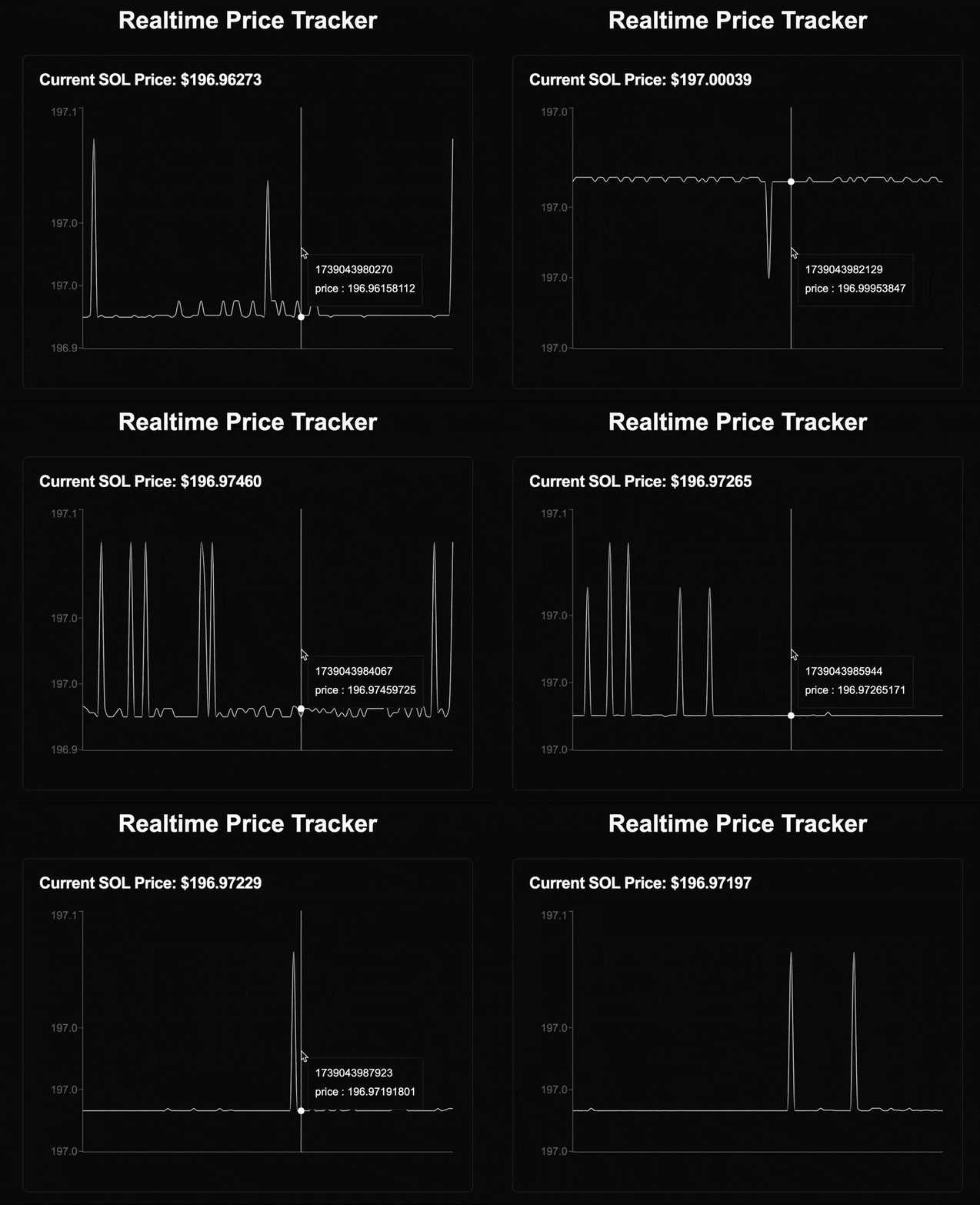
Real-time data is the fuel for HFT. Traders use specialized WebSocket feeds or custom data parsers to monitor order books, recent transactions, and liquidity pool states. These feeds provide the granular, second-by-second data needed to identify arbitrage opportunities or price discrepancies across different DEXs. Delayed data means missed opportunities, so low-latency data pipelines are non-negotiable.
Risk management and profitability checks
High-frequency trading on Solana moves fast, but speed without guardrails is just a faster way to lose capital. The 400ms block time offers a tight window for active management, yet it also means that slippage and failed transactions can compound instantly. Profitability isn't just about finding alpha; it's about surviving the micro-frictions of the network.
To stay profitable, you need to treat risk management as a mechanical layer, not an afterthought. This involves strict slippage controls, robust transaction retry logic, and realistic expectations about latency costs.
Never rely on default slippage settings. In HFT, a 1% slip can erase the edge of a 0.5% arbitrage opportunity. Configure your routers to reject any trade where the price impact exceeds your calculated threshold. If the market moves against you, let the transaction fail rather than execute at a loss.
Solana's congestion means your transaction might sit in the mempool for a full block cycle. HFT strategies require inclusion in the next block. Implement dynamic priority fee logic that scales with network demand. This small cost is the price of admission for speed, ensuring your trades don't expire before they execute.
Track your bot's success rate in real-time. A sudden drop in success rates often indicates network congestion or a broken RPC endpoint. If your success rate falls below a certain threshold (e.g., 95%), pause trading. Continuing to trade in a degraded state increases the risk of failed retries and wasted rent.
Profitability isn't just about total PnL; it's about consistency. Use official metrics to calculate your Sharpe ratio, focusing on short-term returns (seconds to minutes). Aggressive liquidity-taking strategies can generate high Sharpe ratios, but they also carry higher risk of being front-run or sandwiched. Ensure your risk-reward model accounts for these micro-structural risks.
| Metric | Low Risk Approach | High Risk Approach |
|---|---|---|
The goal is not to trade every opportunity, but to trade the right ones with precision. By enforcing these checks, you protect your capital from the inherent volatility of high-frequency DeFi on Solana.
Frequently asked questions about Solana HFT
Is high-frequency trading still profitable on Solana?
Yes, but the margin structure has shifted. Research into market microstructure indicates that aggressive, liquidity-taking HFT strategies remain highly profitable, often generating strong Sharpe ratios over short timeframes (seconds to minutes) [1]. On Solana, this profitability relies on capturing the speed advantage during block transitions rather than just simple arbitrage.
What are the technical barriers to entry?
The primary barrier is infrastructure latency, not just code. Solana’s 400ms block time creates a unique window for active management [2]. To compete, you typically need colocation services near Solana validators and optimized Rust-based execution engines. Standard retail API connections are generally too slow for true HFT strategies.
How do Solana fees impact HFT strategies?
Transaction costs are a critical variable in HFT profitability. While Solana’s fees are significantly lower than Ethereum’s, they are not zero. For high-frequency strategies executing thousands of transactions, even fractional SOL fees can erode thin margins. Effective HFT bots must account for fee structures in their profit-loss calculations and often use priority fees to ensure inclusion during high network congestion.
[1] Baron, M., Brogaard, J., & Kirilenko, A. (2012). "High-Frequency Trading and Market Quality." NBER Conference. [2] Reddit r/algotrading discussion on Solana block timing.
Helpful gear
Use these product recommendations as a starting point, then choose the size, material, and price point that fit how you actually use the gear.


As an Amazon Associate, we may earn from qualifying purchases.
No comments yet. Be the first to share your thoughts!